
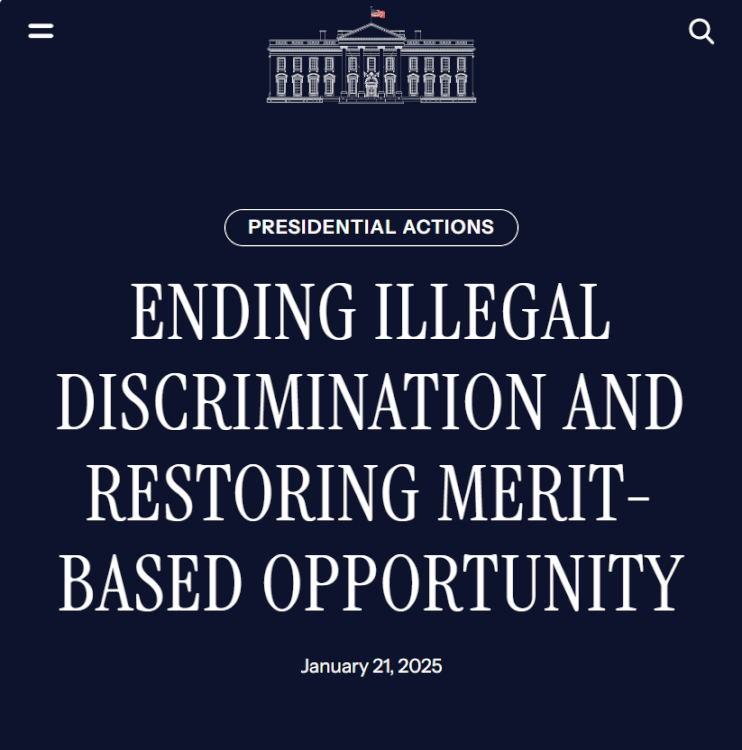
Image source: White HouseDecoding the ‘Ending Illegal Discrimination and Restoring Merit-Based Opportunity’ Order”
On January 21, 2025, the newly issued executive order titled “Ending Illegal Discrimination and Restoring Merit-Based Opportunity” introduced sweeping changes to diversity, equity, and inclusion (DEI) and Equal Opportunity initiatives in the public and private sectors. Below are the overarching takeaways from the order based on my interpretation.
Purpose of the Order
Key Idea: The order claims to ensure that civil-rights laws protecting individuals from discrimination (based on race, color, religion, sex, or national origin) are enforced.
Claim: It argues that current DEI policies and practices violate civil-rights laws by prioritizing race and sex over merit, which it states undermines fairness and excellence.
Goal: To eliminate “illegal” DEI practices and promote “merit-based opportunities.”
The new executive order is written under the guise of reinforcing the principles of the Civil Rights Act of 1964 by emphasizing the enforcement of civil-rights laws. However, it is important to note that this order does not repeal or modify the Civil Rights Act of 1964 itself.
About the Civil Rights Act of 1964
The Civil Rights Act of 1964 is a landmark civil rights and labor law in the United States. It outlaws discrimination based on race, color, religion, sex, or national origin. This Act remains a cornerstone of civil-rights protections in this country, and the new executive order claims to align with its principles.
Key Provisions of the Civil Rights Act of 1964:
- Title I: Guarantees equal voting rights by removing biased registration requirements.
- Title II: Prohibits segregation or discrimination in places of public accommodation involved in interstate commerce.
- Title VII: Bans employment discrimination by trade unions, schools, or employers involved in interstate commerce or doing business with the federal government. It also established the Equal Employment Opportunity Commission (EEOC) to enforce these provisions.
While the Civil Rights Act provides the foundation for ensuring fairness and equality, the new executive order claims that DEI programs undermine these principles by prioritizing identity over merit.
What the Executive Order Does
1. Revokes Previous DEI-Related Orders and Policies
The order cancels several executive orders that promoted diversity and inclusion:
- Environmental Justice (E.O. 12898): Protected minority and low-income communities from environmental harm.
- Diversity in the Federal Workforce (E.O. 13583): Encouraged a more diverse federal workforce.
- Equal Employment Opportunity (E.O. 13672): Expanded protections for LGBTQ+ workers.
- DEI in National Security (2016 Memo): Promoted diversity in national security jobs.
- Affirmative Action in Federal Contracting (E.O. 11246): Mandated affirmative action for federal contractors.
2. Stops Federal Contractors from Promoting DEI
Federal contractors and subcontractors:
- Cannot be required to engage in affirmative action or workforce balancing.
- Must comply strictly with civil-rights laws without considering race, color, sex, religion, or national origin.
- Must certify they don’t operate DEI programs that violate federal laws.
3. Streamlines Federal Contracting
- Reduces the time and cost of federal contracting.
- Removes DEI language and requirements from grant and contract procedures.
4. Encourages the Private Sector to Stop DEI Programs
- Federal agencies are directed to promote a private-sector focus on “merit-based” hiring and policies.
- The Attorney General must submit a report identifying:
- Key sectors and organizations using “discriminatory” DEI programs.
- Strategies to deter or investigate DEI practices in corporations, non-profits, universities, and other institutions.
5. Guides Educational Institutions
- Federal agencies are instructed to issue guidance for schools and colleges on complying with laws prohibiting race-based admissions or employment practices, aligning with the Supreme Court decision in Students for Fair Admissions v. Harvard.
Who It Affects
- Federal Government:
- Agencies must stop all DEI-related programs, guidance, and policies.
- Federal Contractors and Subcontractors:
- Contractors must certify compliance with non-discrimination laws and stop DEI-related initiatives.
- Private Sector:
- The government will pressure corporations, universities, and non-profits to eliminate DEI programs deemed discriminatory.
- Educational Institutions:
- Federal funds will come with stricter enforcement of anti-discrimination laws, affecting admissions and hiring practices.
Exemptions
- Veterans and Persons with Disabilities:
- Lawful preferences for these groups remain in place.
- Free Speech Protections:
- Individuals and institutions can still discuss DEI as part of academic instruction or First Amendment-protected activities.
Implications of the Executive Order
This executive order marks a significant shift that will undoubtedly impact businesses, institutions, and workforce dynamics. Here’s what it means for the workplace:
1. Reduced Representation
- By eliminating DEI initiatives, there’s a risk that workplace diversity will decline, limiting the perspectives and innovation necessary for organizations to thrive.
2. Pressure on Private Sector Programs
- Companies with active DEI programs may face scrutiny, creating a chilling effect on diversity efforts out of fear of regulatory or legal consequences.
3. Potential Misunderstanding of Merit
- The “colorblind” approach proposed by the order fails to address systemic barriers that have historically excluded marginalized groups from opportunities.
4. Operational Impact
- Organizations will need to navigate these changes carefully while ensuring compliance and maintaining equitable practices that foster trust and engagement among employees.
My Perspective
As a certified HR professional with 20 years of experience as a hiring manager and operational leader, I feel compelled to share my perspective. DEI discussions first entered my professional sphere around 2011 or 2012. In my lived experience, never has DEI been introduced, trained, or implemented as a meritless hiring practice focused on quotas or hiring underqualified applicants.
DEI is, and always has been, about intentionality—ensuring that qualified talent from all employable groups is considered and reflected in the workforce.
- Benchmarks ≠ Quotas: While benchmarks are a component of DEI programs, they are not quotas. Hiring less qualified individuals to meet a diversity goal would not only be illegal but also operationally ineffective.
- In my 20 years of leadership, no CEO, CHRO, or hiring manager I’ve worked with has ever advised or directed me to intentionally hire less qualified individuals over more qualified ones to meet a diversity benchmark. To suggest otherwise fundamentally misrepresents what DEI is and what it seeks to achieve.
The narrative that DEI promotes “meritless” hiring is both dangerous and false. It astounds me how misinformation and misrepresentation have now made their way into governing articles that shape the policies of this nation. DEI programs have always been about expanding opportunity, not diminishing merit.
Creating a workforce that reflects the talent and potential of our diverse society should always be the goal.
Final Thoughts
The “Ending Illegal Discrimination and Restoring Merit-Based Opportunity” executive order reflects a broader cultural debate about equity, merit, and opportunity. At CMatt Consulting, we believe in navigating these changes thoughtfully while staying true to your organizational values.
We are here to help you navigate compliance challenges, foster inclusive practices, and build workplaces that are both compliant and equitable. If you’re ready to have a conversation about how this impacts your business or workplace, let’s connect.
Author:
Chanda Adams Matthews, MAOL, SHRM-SCP
CEO, Principal Consultant
CMatt Consulting Firm, Management and HR Consulting Firm
Website: www.cmattconsulting.com
Social Media: @cmattconsulting
Email: info@cmattconsulting.com
Phone: 618-980-6712
